
When Tata Motors launched the Tata Nano back in 2008, it created global buzz as the world’s cheapest car. Designed as the “people’s car,” it was meant to provide safe, affordable four-wheeler mobility for Indian families. While the Nano eventually phased out due to changing consumer expectations and safety concerns, its legacy remains unforgettable.
Now, in the era of electric mobility, a question is gaining momentum: Can the Tata Nano make a comeback as an EV?
With Tata Motors leading India’s EV revolution through the Nexon EV, Tigor EV, and Tiago EV, the idea of a Tata Nano EV seems both exciting and logical. An affordable EV in India could bridge the gap between rising fuel costs and the growing demand for eco-friendly vehicles.
In this article, we explore everything about the Tata Nano EV—its expected features, price, design, launch updates, competition, pros and cons, and why it could be the game-changer for affordable electric mobility in India.
Why India Needs an Affordable EV Like Tata Nano EV
Electric cars are gaining popularity, but most models are priced above ₹8–10 lakh, making them unaffordable for average Indian buyers. This creates a huge gap in the EV market.
Here’s why the Tata Nano EV makes sense:
- High Fuel Prices – Petrol and diesel costs keep rising, making EVs attractive for daily commuters.
- Urban Congestion – A compact EV like Nano would be easy to park and maneuver in crowded cities.
- Lower Running Costs – EVs cost only ₹1–1.5 per km to run, compared to ₹7–10 per km for petrol cars.
- Government Push – Incentives under FAME II and state-level subsidies can make Nano EV more affordable.
- First-Time Buyers – A low-cost EV will attract students, small families, and office commuters.
If priced smartly, the Nano EV could democratize electric mobility in India.
Tata Nano EV – Expected Features
Although Tata Motors hasn’t officially revealed Nano EV details, based on industry trends and Tata’s EV strategy, here’s what we might expect:
🔋 Battery & Range
- A 20–25 kWh lithium-ion battery.
- Range of 150–200 km per charge, perfect for daily city use.
- Fast-charging support (0–80% in about 60 minutes).
⚡ Performance
- Electric motor producing around 40–50 hp.
- Top speed of 100–110 km/h, suitable for city and occasional highway runs.
- Instant torque for smooth traffic handling.
🎨 Design & Styling
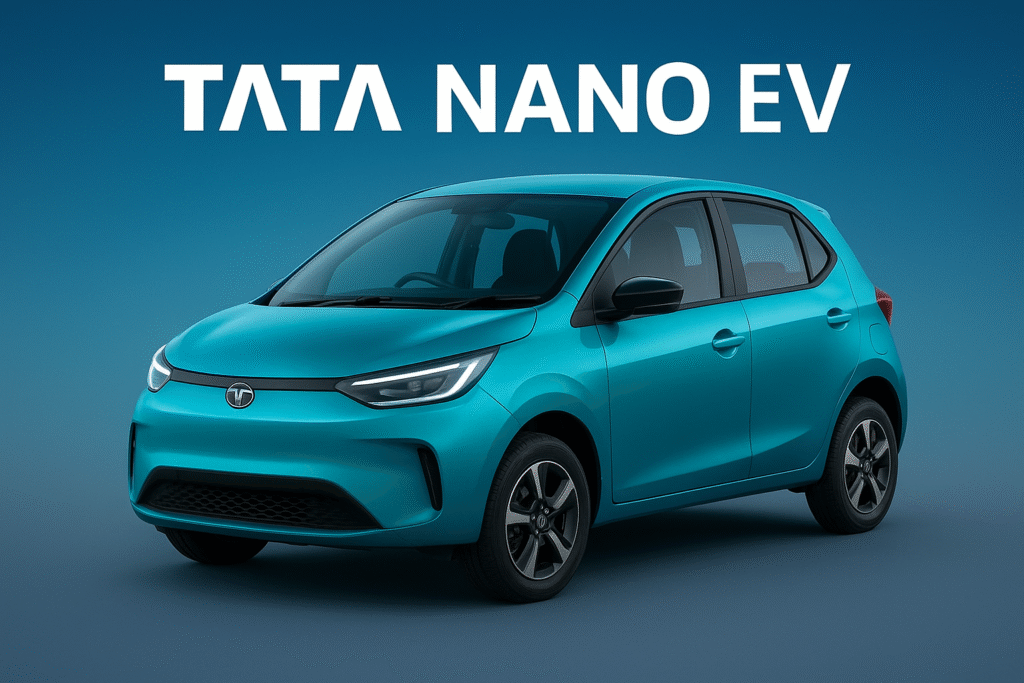
- Compact hatchback design, similar to original Nano but with a modern EV makeover.
- Closed grille, redesigned bumpers, LED headlamps, and sportier alloy wheels.
- Fresh interiors with digital instrument cluster.
📱 Technology & Connectivity
- Touchscreen infotainment with Android Auto & Apple CarPlay.
- Tata’s ZConnect connected car tech.
- Digital driver’s display and regenerative braking.
🛡️ Safety Features
- Dual airbags.
- ABS with EBD.
- Rear parking sensors and reverse camera.
- Strengthened body structure for better crash safety.
Tata Nano EV Price in India (Expected)
Price is the most crucial factor for the Nano EV. Considering Tata’s EV strategy, the Nano EV could be priced around:
- ₹5–6.5 lakh (ex-showroom)
- With subsidies, the effective cost could drop to ₹4.5–5 lakh in some states.
This would make Nano EV the cheapest electric car in India, directly appealing to budget-conscious buyers.
Tata Nano EV – Launch Date Updates
As of now, Tata Motors hasn’t officially confirmed the launch of Nano EV. However, industry experts speculate that if Tata decides to revive Nano in EV form, it could be revealed in late 2025 or early 2026.
Given Tata’s strong EV roadmap and market leadership, the Nano EV could be a part of Tata’s next phase of affordable EVs, following the success of Tiago EV.
Competition for Tata Nano EV
If launched, the Tata Nano EV would compete with:
- MG Comet EV – Price: ₹7.98 lakh, small city car with premium features.
- PMV EaS-E – Priced around ₹4.8 lakh, India’s most affordable EV currently.
- Upcoming Maruti Suzuki EVs – Expected in 2025, likely to target budget segment.
- Mahindra Micro EV (under development) – Another potential rival in affordable EV space.
Nano EV’s advantage: Tata’s wide service network, trust factor, and competitive pricing.
Pros & Cons of Tata Nano EV
✅ Pros
- Most affordable EV option.
- Compact size – perfect for Indian cities.
- Low running & maintenance cost.
- Eco-friendly mobility for first-time buyers.
- Backed by Tata Motors’ EV expertise.
❌ Cons
- Limited highway usability due to range.
- Smaller boot and cabin space.
- Perception issues from old Nano’s safety image.
- Charging infrastructure in India still growing.
Why Tata Might Actually Launch Nano EV
Tata Motors has been leading the EV market with a 70%+ share. With Nexon EV, Tigor EV, Tiago EV, and Punch EV, Tata has cars across different price brackets.
What’s missing?
👉 An ultra-low-cost EV for students, two-wheeler upgraders, and city commuters.
This is where the Nano EV perfectly fits in. It revives the legacy of the “people’s car” and aligns with Tata’s EV strategy to bring electric mobility for the masses.
FAQs About Tata Nano EV
1. Is Tata Nano EV officially confirmed?
Not yet. Tata hasn’t made an official announcement, but speculations are strong.
2. What will be the price of Tata Nano EV?
Expected to be around ₹5–6.5 lakh (ex-showroom).
3. What range can we expect from Tata Nano EV?
Likely between 150–200 km on a full charge.
4. When will Tata Nano EV launch in India?
If launched, it may come by late 2025 or early 2026.
5. Who are the competitors of Nano EV?
MG Comet EV, PMV EaS-E, and upcoming budget EVs from Maruti and Mahindra.
Final Thoughts
The Tata Nano EV could be a landmark product for India—reviving Ratan Tata’s vision of a safe, affordable car, but this time powered by clean energy.
If priced right, it can bring millions of first-time buyers into the EV ecosystem, reduce dependence on fossil fuels, and make green mobility truly mainstream in India.
While official confirmation is still awaited, the idea of Nano EV has already captured the imagination of auto enthusiasts and budget buyers alike. If Tata pulls this off, the Nano EV could be the real “people’s EV” of India.